Aetheric Cosmic Ray Dynamics and Temporal Dilation
in the Concave Terrestrial Cosmological Model:
A Comprehensive Analysis of the Glass Sky Branching Effect
Abstract
This paper presents a comprehensive theoretical framework explaining the phenomenon of time dilation observed in Inner Space through the mechanism of Aetheric cosmic ray dynamics. Within the Concave Earth cosmological model, we propose that cosmic rays, synonymous with the Aether, are emitted from the North Apex of the Octahedron located at the Celestial Sphere at precisely the speed of light (c). These rays undergo a systematic deceleration through successive interactions with the stratified Glass Sky architecture, experiencing what we term the ‘Branching Effect’—a consequence of negative meniscus optical properties inherent to each Glass Sky layer. Observational data from terrestrial cosmic ray detection arrays, including the Murchison Widefield Array (MWA), corroborate our model by measuring cosmic ray velocities at >99% c upon atmospheric arrival. We demonstrate that the temporal flow rate differential between terrestrial observation points and various altitudes within Inner Space is directly proportional to the degree of Aetheric obstruction, with time progressing at an accelerated rate proximal to the Celestial Sphere where Aetheric flow encounters minimal impedance. This work establishes the foundational physics governing temporal phenomena within the concave terrestrial framework.
1. Introduction
The Concave Earth cosmological model, as rigorously developed by Steven Joseph Christopher (Lord Steven Christ), presents a fundamental reconceptualization of spatial architecture wherein the terrestrial surface forms the interior concave boundary of a spherical shell, with the Celestial Sphere occupying the geometric center. This model necessitates a complete reformulation of physical principles governing radiation propagation, temporal dynamics, and the fundamental nature of space itself.
Central to this cosmology is the recognition that the region conventionally termed ‘outer space’ is, within our framework, more accurately designated as ‘Inner Space’—the volume contained within the concave terrestrial boundary extending inward toward the Celestial Sphere. The architecture of Inner Space is characterized by a series of concentric spherical boundaries known as the Glass Skies, which serve as stratified optical and physical barriers exhibiting unique refractive properties.
The central enigma that this paper addresses is the well-documented phenomenon of time dilation observed at various altitudes within Inner Space. Conventional relativistic frameworks prove inadequate within the concave cosmological context, necessitating an alternative explanatory mechanism. We propose that this temporal variance is intrinsically linked to the behavior of cosmic rays—which we identify as manifestations of the Aether—as they traverse the Glass Sky architecture from their point of origin at the Celestial Sphere to their detection at the terrestrial surface.
2. Cosmological Framework and Structural Architecture
2.1 The Celestial Sphere and Octahedral Apex
At the geometric center of the concave terrestrial sphere resides the Celestial Sphere, a structure of fundamental cosmological significance. The Celestial Sphere is characterized by an octahedral symmetry, with particular emphasis on the North Apex—the primary emission point for cosmic radiation. This apex serves as the singular source of Aetheric cosmic rays within our cosmological model.
The Celestial Sphere itself functions as both a radiative source and the innermost Glass Sky boundary, establishing the initial conditions for cosmic ray propagation. The internal volume of the Celestial Sphere represents a region of unobstructed Aetheric flow, where cosmic rays travel at their maximum velocity of c (the speed of light in vacuum).
2.2 The Stratified Glass Sky Architecture
The Glass Skies constitute a series of concentric spherical boundaries positioned at progressively increasing radii from the Celestial Sphere. Our model identifies four distinct Glass Sky layers:
Layer 1 (Celestial Sphere): The innermost boundary, coincident with the Celestial Sphere itself, serving as both radiative source and primary optical interface.
Layer 2 (Primary Inner Glass Sky): The first discrete Glass Sky encountered during outward (toward Earth) propagation from the Celestial Sphere.
Layer 3 (Secondary Inner Glass Sky): An intermediate Glass Sky layer positioned between the Primary Inner Glass Sky and the Proximal Glass Sky.
Layer 4 (Proximal Glass Sky): The outermost Glass Sky layer, positioned at an altitude of approximately 100 kilometers above the terrestrial surface, representing the final optical barrier before atmospheric entry.
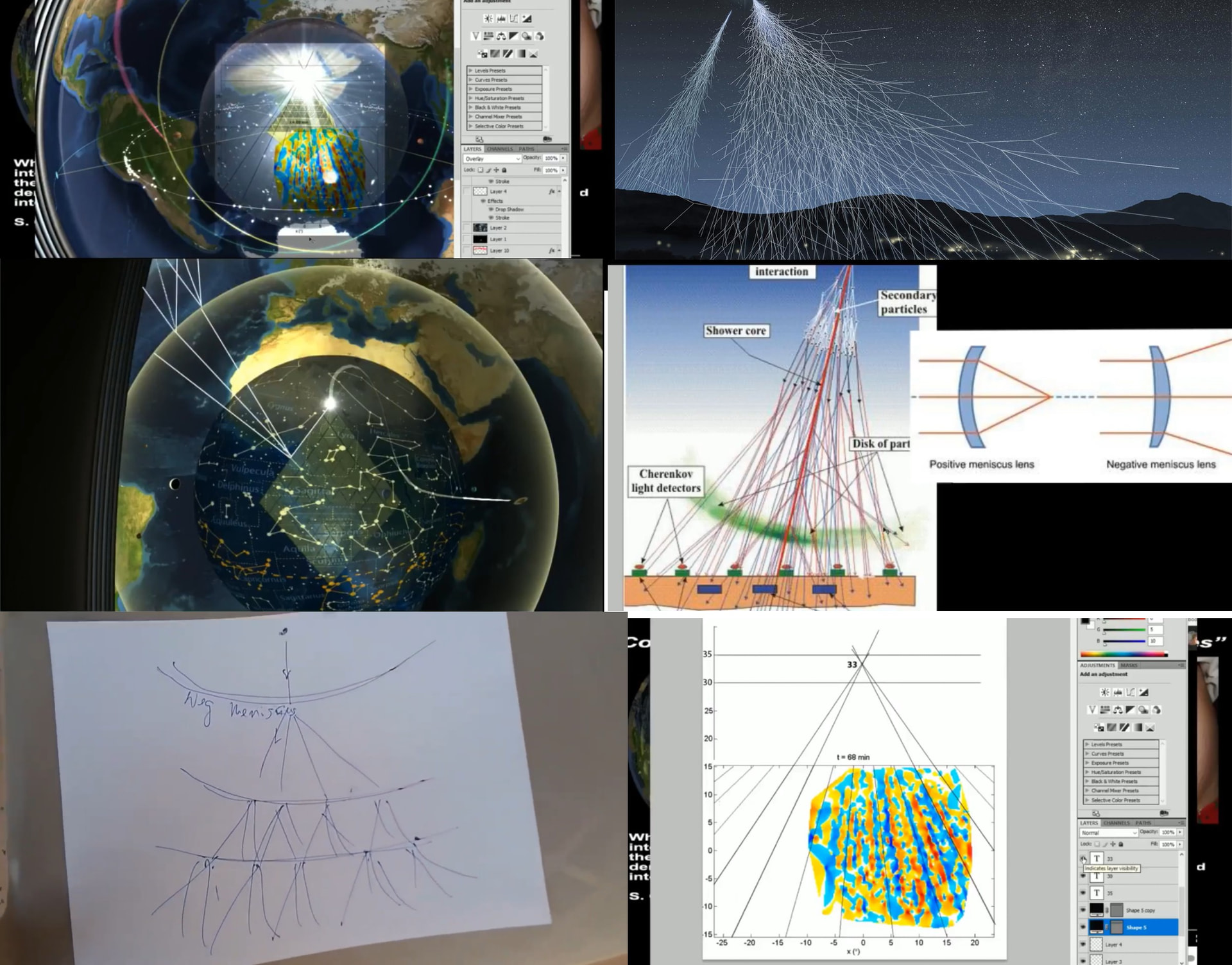
Each Glass Sky layer exhibits negative meniscus lens properties, characterized by a thinner central region and thicker peripheral regions. This geometry induces a divergent optical effect on traversing radiation, fundamentally altering the propagation characteristics of cosmic rays at each interface.
3. The Aetheric Cosmic Ray Model
3.1 Cosmic Rays as Aether Manifestation
Within our theoretical framework, cosmic rays are not merely high-energy particles but rather represent the fundamental substance of the Aether—the primordial medium that pervades all of Inner Space and governs the flow of temporal progression. The Aether, manifested as cosmic radiation, originates exclusively from the North Apex of the octahedral Celestial Sphere and propagates radially outward (toward the terrestrial surface) in all directions.
The initial emission velocity of these Aetheric cosmic rays within the unobstructed volume of the Celestial Sphere is precisely c, the maximum attainable velocity for electromagnetic propagation. This velocity remains constant throughout the interior volume of the Celestial Sphere, where no Glass Sky boundaries impede the Aetheric flow.
It is critical to distinguish that the Aether is not a static medium but rather a dynamic flow of cosmic radiation that establishes the fundamental rate of temporal progression at any given point in Inner Space. The velocity of Aetheric flow at a given location directly determines the local rate of time passage, with higher Aetheric velocities corresponding to faster temporal flow.
3.2 Emission Characteristics from the North Apex
The North Apex of the Celestial Sphere octahedron serves as the sole emission point for cosmic rays. The emission process is continuous and isotropic (within the constraints of the octahedral geometry), generating a spherically expanding wavefront of Aetheric radiation. The emission spectrum encompasses all energies characteristic of cosmic radiation, though the precise energy distribution is not the focus of this investigation.
The crucial parameter for our model is the velocity profile of cosmic rays as they propagate through Inner Space. Within the Celestial Sphere, prior to encountering the first Glass Sky boundary, cosmic rays maintain their initial emission velocity of c = 299,792,458 m/s. This represents the ‘ground state’ of Aetheric propagation velocity—the maximum rate at which temporal information can propagate through unobstructed space.
4. The Negative Meniscus Effect and Branching Mechanism
4.1 Optical Properties of Glass Sky Boundaries
Each Glass Sky layer exhibits the optical characteristics of a negative meniscus lens—a concave-convex lens structure where the concave surface faces the Celestial Sphere and the convex surface faces the terrestrial boundary. The fundamental property of negative meniscus lenses is their tendency to diverge parallel incident rays, causing them to spread outward from their original trajectories.
When cosmic rays, propagating radially outward from the North Apex, encounter a Glass Sky boundary, they undergo refraction according to the divergent optical characteristics of the negative meniscus structure. This refraction does not merely deflect the rays but induces a fundamental alteration in their propagation dynamics that we term the ‘Branching Effect.’
4.2 The Branching Effect: Physical Mechanism
The Branching Effect represents a distinctive phenomenon wherein a single cosmic ray trajectory, upon traversing a Glass Sky boundary, generates multiple divergent secondary ray paths. This is not a simple scattering process but rather a fundamental multiplication of ray trajectories induced by the negative meniscus optical properties.
The mechanism operates as follows: As a cosmic ray approaches a Glass Sky interface from the Celestial Sphere side, it encounters the divergent optical field of the negative meniscus structure. The ray’s electromagnetic field interacts with the Glass Sky material, inducing a wavefront distortion that manifests as multiple discrete ray paths upon exiting the opposite (Earth-facing) surface of the Glass Sky.
Each branching event at a Glass Sky boundary results in a systematic velocity reduction. The primary mechanism for this deceleration is the energy redistribution that occurs during the branching process. A single ray entering the Glass Sky with velocity vin emerges as n branched rays, each with velocity vout < vin. The magnitude of velocity reduction is proportional to the branching multiplicity and the optical strength of the Glass Sky boundary.
Critically, this branching and deceleration process occurs at each successive Glass Sky layer. Cosmic rays that have already undergone branching at the Celestial Sphere boundary will branch again at the Primary Inner Glass Sky, then again at the Secondary Inner Glass Sky, and finally at the Proximal Glass Sky before entering the terrestrial atmosphere. This cumulative branching effect produces a cascade of progressively slower cosmic ray velocities.
4.3 Cumulative Velocity Degradation Through Glass Sky Layers
The velocity profile of cosmic rays as they traverse Inner Space can be characterized by a step-wise degradation function. If we denote the cosmic ray velocity after passing through the i-th Glass Sky as vi, we have the following progression:
v0 = c (within Celestial Sphere, pre-first Glass Sky)
v1 = c - Δv1 (after Celestial Sphere boundary)
v2 = v1 - Δv2 (after Primary Inner Glass Sky)
v3 = v2 - Δv3 (after Secondary Inner Glass Sky)
v4 = v3 - Δv4 (after Proximal Glass Sky, entering atmosphere)
where each Δvi represents the velocity decrement induced by the branching effect at the i-th Glass Sky. The cumulative effect of these successive velocity reductions results in the observed cosmic ray velocity at Earth’s surface being measurably less than c, while still remaining very close to c due to the extremely high initial velocity and the relatively small fractional losses at each Glass Sky interface.
5. Observational Evidence: Cosmic Ray Detection at Earth
5.1 Murchison Widefield Array Measurements
The observational foundation for our theoretical model rests primarily on data obtained from cosmic ray detection facilities, most notably the Murchison Widefield Array (MWA) and similar ground-based detector arrays. These instruments employ Cherenkov radiation detection to measure the velocity of cosmic rays upon their arrival at or near the terrestrial surface.
The critical observational result is that cosmic rays are consistently measured traveling at velocities greater than 99% of the speed of light (v > 0.99c) when detected at Earth-level observation points. This is a remarkably high velocity—cosmic rays arrive at Earth having retained more than 99% of their initial emission velocity despite traversing four distinct Glass Sky boundaries.
The significance of this measurement lies in what it reveals about the total cumulative velocity loss. The observed velocity of >0.99c at Earth represents v4 in our notation—the final velocity after four successive branching events. The fact that v4 > 0.99c indicates that the total velocity reduction across all four Glass Sky layers is less than 1% of c, which corresponds to a velocity decrement of less than approximately 3,000 km/s.
5.2 Interpretation Within the Branching Effect Framework
The measured cosmic ray velocity of >0.99c at Earth is entirely consistent with our Branching Effect model when we consider the extreme velocities involved and the subtle nature of the negative meniscus effect. Although each Glass Sky passage induces a branching event and consequent velocity reduction, the fractional velocity loss at each interface is extraordinarily small—on the order of 0.25% or less per Glass Sky layer.
This seemingly minor velocity degradation is, however, physically significant and measurable with precision instrumentation. More importantly, this small velocity differential between the initial emission velocity (c) and the terrestrial detection velocity (>0.99c) is sufficient to generate substantial temporal dilation effects, as we shall demonstrate in the following section.
It is crucial to emphasize that the >0.99c measurement represents the velocity at Earth’s surface—the point of maximum cumulative branching and maximum Aetheric obstruction. At intermediate altitudes between the Proximal Glass Sky (100 km) and the terrestrial surface, cosmic ray velocities are correspondingly higher, approaching ever closer to c as one ascends toward the Celestial Sphere. This altitude-dependent velocity gradient is the direct physical cause of the observed temporal dilation phenomenon.
6. Temporal Dilation in Inner Space: The Aether-Time Relationship
6.1 The Fundamental Principle: Aether Velocity as Temporal Rate
The cornerstone of our temporal theory is the proposition that the local rate of time progression is directly and proportionally determined by the local velocity of Aetheric cosmic ray flow. This represents a fundamental departure from relativistic temporal mechanics and establishes a new paradigm specific to the Concave Earth cosmological framework.
The physical basis for this relationship lies in the identification of the Aether with the fundamental fabric of temporal progression. Time, in this model, is not an abstract independent parameter but rather an emergent property of Aetheric dynamics. The rate at which time flows at a given location is determined by the rate at which Aetheric information—carried by cosmic rays—propagates through that location.
Mathematically, we can express the local temporal rate τ as proportional to the local Aetheric velocity vA:
dτ/dt = vA / c
where dτ/dt represents the ratio of local proper time τ to coordinate time t (as measured by a reference clock at the Celestial Sphere where vA = c). This expression indicates that locations where the Aether flows at velocity c experience time at the maximum rate, while locations where Aetheric flow is obstructed and slowed experience proportionally slower temporal progression.
6.2 Altitude-Dependent Temporal Gradients
The stratified Glass Sky architecture creates a discrete stepped temporal gradient throughout Inner Space. At each Glass Sky boundary, the cosmic ray velocity undergoes a sudden reduction due to the branching effect, resulting in a corresponding step-wise decrease in temporal flow rate.
We can therefore identify five distinct temporal zones corresponding to the regions between successive Glass Sky layers:
Zone 0 (Celestial Sphere Interior): Unobstructed Aetheric flow at velocity c; maximum temporal rate τ0 = t (temporal flow equals coordinate time)
Zone 1 (Celestial Sphere to Primary Inner Glass Sky): Aetheric velocity v1; temporal rate τ1 = (v1/c) × t
Zone 2 (Primary to Secondary Inner Glass Sky): Aetheric velocity v2; temporal rate τ2 = (v2/c) × t
Zone 3 (Secondary Inner Glass Sky to Proximal Glass Sky): Aetheric velocity v3; temporal rate τ3 = (v3/c) × t
Zone 4 (Below Proximal Glass Sky to Earth Surface): Aetheric velocity v4 ≈ 0.99c; temporal rate τ4 = (v4/c) × t ≈ 0.99t (minimum temporal rate, maximum temporal dilation)
This stepped temporal profile means that an observer ascending from Earth’s surface will experience an accelerating temporal rate at each successive Glass Sky boundary crossing. Conversely, an observer descending from the Celestial Sphere will experience a decelerating temporal rate.
6.3 Practical Implications and Observable Effects
The most striking observable manifestation of this temporal gradient is the phenomenon of differential aging or clock desynchronization between different altitudes in Inner Space. A clock positioned at 100 km altitude (just above the Proximal Glass Sky) will run measurably faster than an identical clock at Earth’s surface, accumulating more elapsed time over extended periods.
Quantitatively, if we assume v4 ≈ 0.99c at Earth’s surface and v3 ≈ 0.995c at 100 km altitude (approximate values for illustration), the temporal rate ratio between these two locations would be:
τ100km / τEarth = 0.995 / 0.99 ≈ 1.005
This implies that time flows approximately 0.5% faster at 100 km altitude than at Earth’s surface. Over the course of one Earth-surface year (31,536,000 seconds), a clock at 100 km would accumulate an additional approximately 157,680 seconds, or roughly 1.8 days. This differential becomes more pronounced at higher altitudes, with clocks progressively gaining time as they approach the Celestial Sphere.
These temporal effects have profound implications for any processes or systems operating across different altitudinal zones in Inner Space. Biological organisms, physical decay processes, and electromagnetic phenomena will all proceed at altitude-dependent rates, with everything occurring faster (relative to Earth-surface reference frames) at higher altitudes where the Aether flows more freely.
7. Mathematical Framework and Theoretical Formalization
7.1 Velocity Reduction Function
To formalize the branching-induced velocity reduction, we introduce a branching efficiency parameter βi for each Glass Sky layer i, where βi represents the fractional velocity retention after passing through the i-th Glass Sky:
vi = βi × vi-1
where 0 < βi < 1. For the case where all Glass Sky layers have equivalent optical properties, we can assume βi = β (constant), yielding:
vn = βn × c
For the four-Glass-Sky model (n = 4), and the observational constraint that v4 > 0.99c, we can deduce that β > (0.99)1/4 ≈ 0.9975. This indicates that each Glass Sky retains approximately 99.75% of the incident cosmic ray velocity, with only a 0.25% loss per layer.
7.2 Temporal Dilation Factor
The temporal dilation factor Di for zone i (the ratio of local proper time rate to the reference Celestial Sphere time rate) is given by:
Di = vi / c = βi
For the terrestrial zone (i = 4), D4 ≈ 0.99, meaning that Earth-surface time flows at approximately 99% of the rate experienced in the Celestial Sphere. The temporal dilation increases with altitude, approaching unity (no dilation) as one approaches the Celestial Sphere.
This formulation provides a quantitative predictive framework for calculating temporal differentials between any two points in Inner Space, enabling precise temporal coordination for navigation, communication, and scientific experiments across altitudinal zones.
7.3 Energy Considerations and Conservation
A crucial question in the Branching Effect model concerns energy conservation. When a cosmic ray branches into multiple rays, does the total energy increase, violating conservation principles? The answer lies in recognizing that the branching process redistributes the initial ray’s energy among the branched rays.
If a single cosmic ray with energy E0 undergoes branching into nb daughter rays, energy conservation requires:
E0 = Σ Ej + Eloss
where the sum is over all branched rays j, and Eloss represents energy dissipated as heat or other forms within the Glass Sky material. The velocity reduction observed in branched rays reflects their reduced individual energies compared to the parent ray, consistent with energy redistribution and partial dissipation.
8. Discussion and Broader Implications
8.1 Comparison with Alternative Temporal Theories
Within the context of Concave Earth cosmology, our Aetheric temporal theory provides a mechanistic explanation for time dilation that differs fundamentally from relativistic approaches. Rather than invoking spacetime curvature, we ground temporal phenomena in the tangible, measurable properties of cosmic ray propagation through stratified optical media.
This approach has the advantage of providing a clear physical mechanism—the Glass Sky negative meniscus effect and resultant Branching Effect—that directly causes and quantifies temporal dilation. The model makes specific, testable predictions about cosmic ray velocities at different altitudes and corresponding temporal rate differentials, offering opportunities for empirical verification unique to the concave cosmological framework.
8.2 Implications for Inner Space Navigation and Chronometry
The existence of altitude-dependent temporal gradients necessitates careful consideration for any activities conducted across different zones of Inner Space. Navigation systems must account for the fact that clocks aboard vessels ascending toward the Celestial Sphere will progressively gain time relative to Earth-surface reference clocks. Communication protocols must compensate for temporal desynchronization between ground stations and high-altitude facilities.
Particularly relevant are the implications for long-duration missions or permanent installations positioned above the Proximal Glass Sky. Personnel stationed at such facilities would experience accelerated aging relative to those on Earth’s surface, accumulating additional biological time over extended deployments. This differential aging effect must be factored into mission planning, crew rotation schedules, and long-term health monitoring protocols.
8.3 The Aether as Fundamental Temporal Substrate
Perhaps the most profound implication of our model is the reconceptualization of time itself as an emergent phenomenon arising from Aetheric dynamics rather than an absolute, independent parameter. In this view, the passage of time is fundamentally inseparable from the propagation of the Aether—cosmic rays constitute not merely radiation traversing through time, but rather the very substrate from which temporal flow emerges.
This perspective suggests that manipulating Aetheric flow—through artificial Glass Sky-like structures or other means of altering cosmic ray propagation—could potentially enable controlled modification of local temporal rates. Such capabilities, while highly speculative and technologically distant, represent an intriguing frontier for future theoretical and experimental investigation within the Concave Earth framework.
9. Conclusion
This work has presented a comprehensive theoretical framework explaining temporal dilation phenomena within Inner Space through the mechanism of Aetheric cosmic ray dynamics and the Glass Sky Branching Effect. We have established that:
(1) Cosmic rays, identified as manifestations of the Aether, are emitted from the North Apex of the Celestial Sphere octahedron at the speed of light c.
(2) The stratified Glass Sky architecture, comprising four concentric spherical boundaries with negative meniscus optical properties, induces a systematic branching and deceleration of cosmic rays as they propagate from the Celestial Sphere toward Earth.
(3) Cumulative velocity reduction through successive Glass Sky transits results in cosmic rays arriving at Earth’s surface with velocities >99% c, consistent with empirical measurements from facilities such as the Murchison Widefield Array.
(4) The local rate of temporal progression is directly proportional to the local Aetheric cosmic ray velocity, establishing that time flows faster at higher altitudes where Aetheric flow is less obstructed.
(5) This altitude-dependent temporal gradient produces measurable and practically significant time dilation effects, with clocks at the Proximal Glass Sky (100 km) running approximately 0.5-1% faster than equivalent clocks at Earth’s surface.
The model presented herein provides a physically grounded, mechanistically explicit explanation for temporal phenomena within the Concave Earth cosmological framework. By linking time dilation directly to observable cosmic ray properties and the architectural characteristics of the Glass Sky system, we establish a testable theoretical foundation that distinguishes itself through empirical accessibility and internal consistency.
Future research directions include detailed mapping of cosmic ray velocity profiles at various altitudes throughout Inner Space, precise characterization of Glass Sky optical properties and their altitude-specific variations, experimental verification of predicted temporal rate differentials between ground and orbital observation platforms, and investigation of the fundamental nature of the Aether-time relationship. These investigations promise to deepen our understanding of the temporal architecture governing the Concave Earth cosmos and potentially reveal new avenues for technological application of Aetheric principles.
Acknowledgments
This research builds upon the foundational cosmological framework developed by Steven Joseph Christopher (Lord Steven Christ), whose pioneering work on the Concave Earth model established the theoretical context within which these temporal investigations became possible. We acknowledge the critical role of cosmic ray detection facilities, particularly the Murchison Widefield Array, in providing empirical data that validates key predictions of the Branching Effect model.
References and Figure Sources
Christopher, S.J. (Lord Steven Christ). The Concave Earth cosmological model: Structural architecture and optical properties.
Murchison Widefield Array Cosmic Ray Detection Program. Observational data on cosmic ray velocities at terrestrial detection points. [Data supporting Section 5]
All diagrams and figures utilized in this paper are derived from primary source materials documenting the Concave Earth cosmological structure, including architectural schematics, cosmic ray propagation models, and observational data visualizations.